
A signed, notarized page recorded at the county clerk’s office can move a house to your kids without a judge ever touching it. Left to a will alone, that same house can sit in limbo for the better part of a year. I’ve watched both versions play out across Texas, and the difference almost always comes down to paperwork someone either filed or didn’t. If you own property in Texas and want your heirs to inherit without a courtroom, you have real options to avoid probate. Most of them cost less than a decent appliance.
What Does Probate Mean for Texas Property Owners?
A Seguin widow walked into a title company with a deed in her name and walked out with a check nine days later.
The whole subject is that gap. Probate is the court process that proves who owns what after someone dies. It’s relatively simple in Texas, yet it’s still a process with filings, waiting periods and lawyers. Bexar, Harris, Dallas and a handful of other large Texas counties run specialized statutory probate courts. Smaller counties handle these cases in the constitutional county court. So where your parent lived shapes the experience as much as what they owned.
Families find it frustrating: the house is often the only reason they’re in court at all. Bank accounts with beneficiaries pass instantly. Life insurance pays out.
A couple of years ago I worked with a longtime landlord in San Marcos whose mother had just moved into assisted living. The duplex deed was still in the mother’s name alone. She’d been collecting rent for six years and had never once thought about what happened if her mom passed. We spent a Thursday afternoon with her estate attorney getting a recorded deed in place so the duplex could avoid probate.
Heirs in Texas get tools to avoid probate that other states simply don’t offer. Spouses can sign a community property survivorship agreement. It moves community property to the surviving spouse automatically at death, so the couple can avoid probate on it. That’s one lever. Recorded deeds are another, and I’ll get to those.
What Is the Probate Process in Texas If You Don’t Avoid It?
Court filing fees for a Texas estate generally land between $360 and $500, depending on the county, but that’s the cheap part. Attorney work is where the real money goes. Flat fees for a typical independent administration commonly run $3,000 to $7,000. Muniment of title cases land lower, at $1,500 to $3,500.
An independent administration typically takes three to six months, while a muniment of title case often wraps in one to two months. Dependent administration, where the judge approves nearly every move, stretches well past a year.
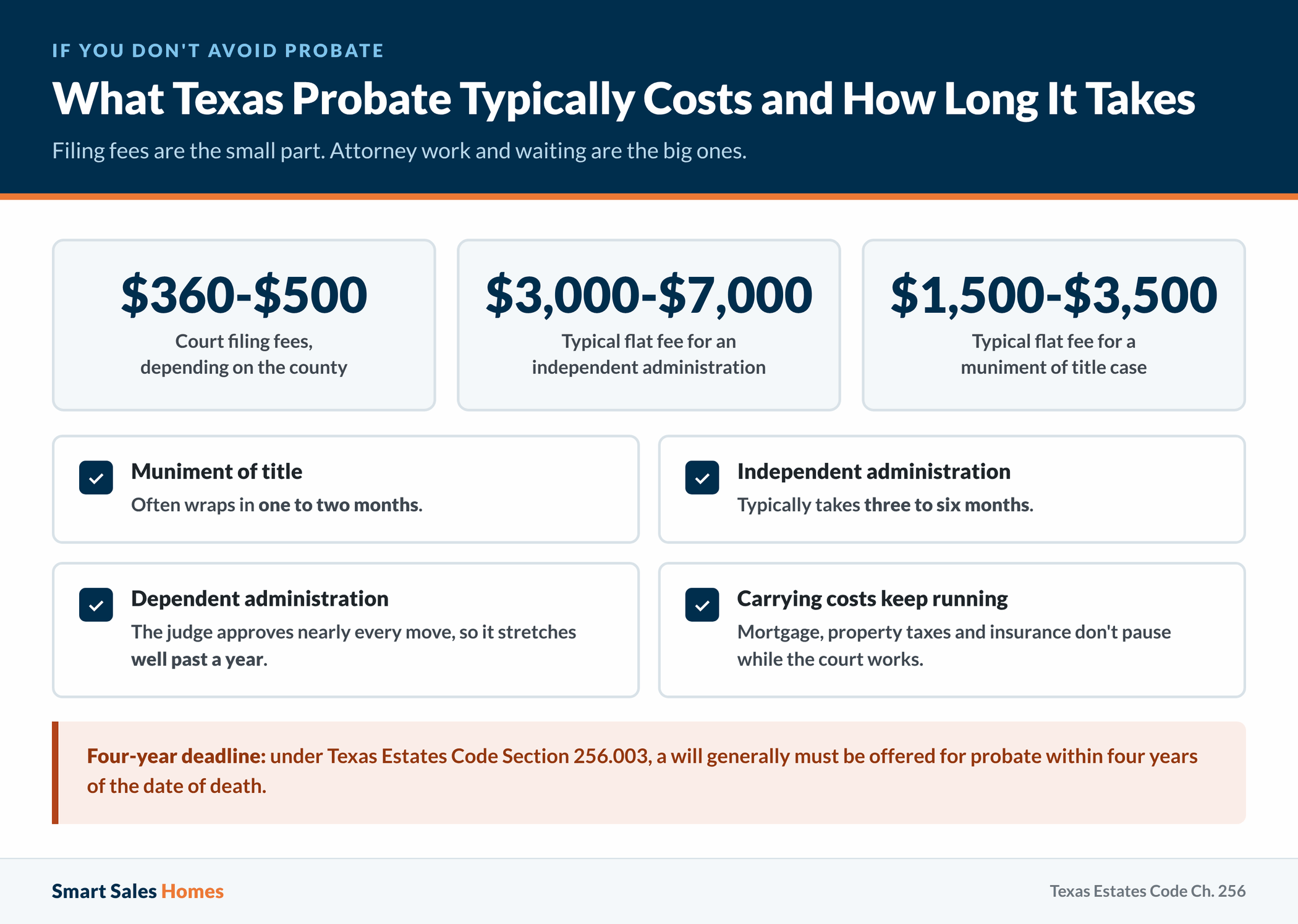
One deadline there ends cases. Under Texas Estates Code Section 256.003, a will must generally be offered for probate within four years of the date of death. Past that mark, the court can’t issue letters testamentary. An applicant who proves they weren’t at fault for the delay may still get the will admitted. In that case it works only as a muniment of title. You can read the chapter yourself at the Texas Estates Code on the legislature’s site.
Four years can evaporate when a family is grieving, scattered across three cities, and nobody wants to be the one who hires the lawyer.
Can your heirs carry a mortgage, taxes, and insurance for six months while a court sorts out paperwork? The real question behind every decision to avoid probate is that one. Property taxes don’t pause for grief in Texas, and neither does a roof that needs replacing.
Which Texas Assets Can Skip Probate Entirely?
The hard part isn’t the homestead. It’s the assets nobody bothered to title correctly.
Retirement accounts, life insurance, and payable-on-death bank accounts move to named beneficiaries without any court involvement. Real estate is the stubborn one, which is exactly why Texas created a deed that lets owners avoid probate on it.
A transfer on death deed passes a house or land to a named beneficiary when the owner dies, without probate. This only works if it’s recorded in the county clerk’s deed records before the owner’s death. Chapter 114 of the Texas Estates Code, the Texas Real Property Transfer on Death Act, has applied since September 1, 2015. Section 114.055 sets three requirements: the formalities of a recordable deed, language stating the transfer happens at death, and recording in the county where the land sits.
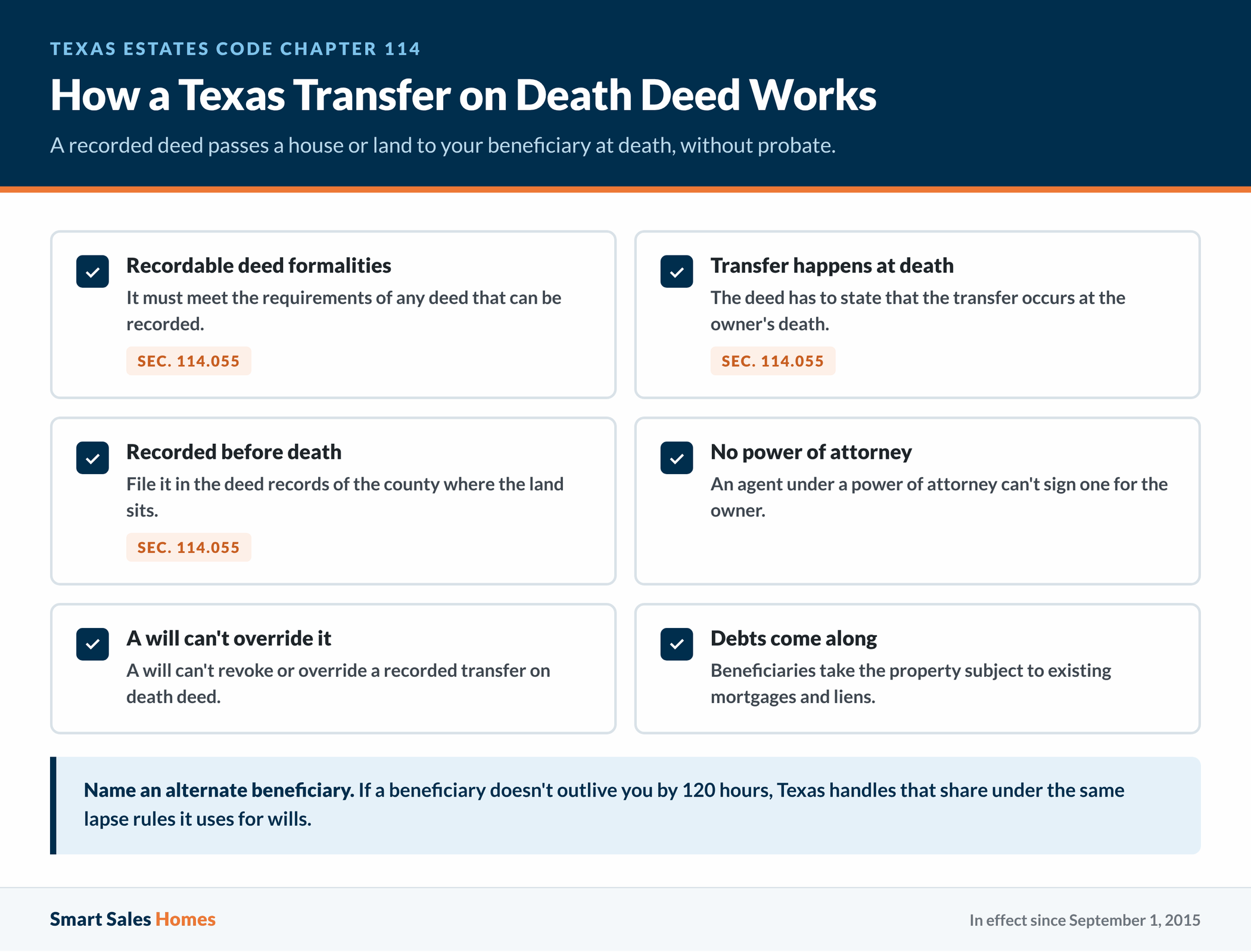
Families get caught sideways by a few details inside Chapter 114. An agent under a power of attorney cannot sign one of these deeds for the owner. The beneficiary doesn’t need to be told about it, accept it, or pay anything. This surprises a lot of people who assume inheritance always requires some action on their part. A will also cannot revoke or override a recorded transfer on death deed.
Beneficiaries don’t inherit free and clear, either. They take the property subject to existing mortgages and liens. It can also be reached for estate debts if the probate estate isn’t enough to cover them. Naming an alternate beneficiary is the cheapest insurance in the whole document. Without one, a beneficiary who doesn’t outlive you by 120 hours leaves that share to the same lapse rules Texas applies to wills. The free statutory form lives with the Texas State Law Library resources your attorney can point you to.
Does a Living Trust Help You Avoid Probate in Texas?
A San Antonio seller called me about her late father’s rental on the east side. She was certain the trust he’d paid good money for had handled everything. The trust was real, properly drafted, and the house had never been deeded into it.
An unfunded trust is a very expensive filing cabinet. The document only controls what’s actually titled in its name, so the deed has to be signed over to the trustee and recorded.
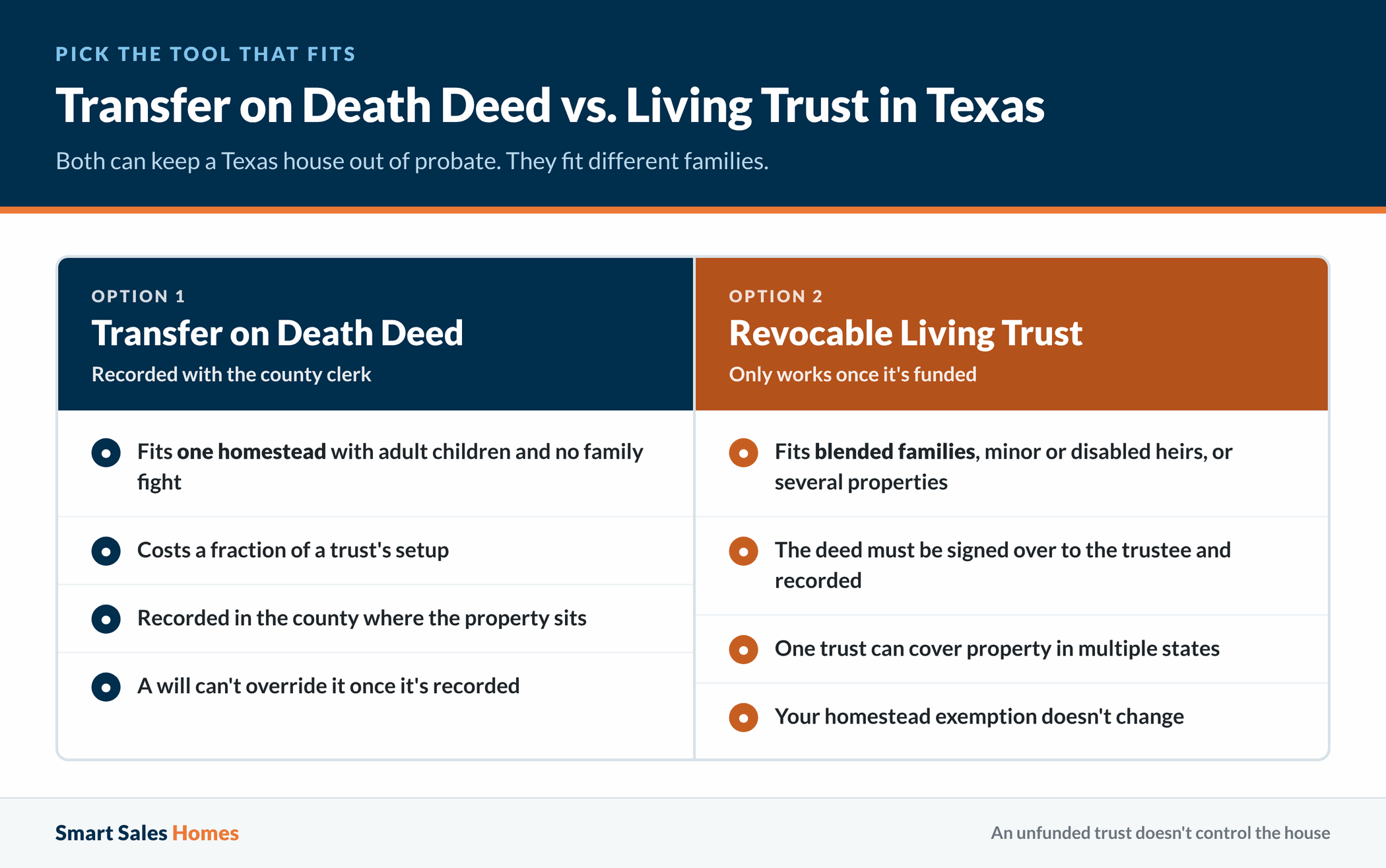
Funded correctly, a revocable living trust is a strong way to avoid probate in Texas. You stay trustee during your life, you can sell or refinance, and your homestead exemption doesn’t change at all. At death, your successor trustee takes over and can convey the property without a courthouse visit.
A single trust can cover property in multiple states. It also spares the family a separate ancillary probate in each state where real estate sits. Families in Texas with a lake place in Oklahoma or acreage in New Mexico should pay attention to that.
My honest opinion: a lot of Texas homeowners get sold trusts they don’t need. Say you own one house in Round Rock, you’ve named your kids, and nobody’s fighting. A recorded deed lets you avoid probate there for a fraction of the setup cost. Independent administration in Texas already runs lighter than probate in most states. Executors act without ongoing court supervision under Estates Code Chapter 401.
Trusts make sense for blended families, minor beneficiaries, disabled heirs, or anyone with several properties and a plan for who gets what. Pick the tool that matches the mess you actually have, not the one that sounds most sophisticated.
Can Business Interests Avoid Probate in Texas?
“What happens to my LLC if I die tomorrow?”
The answer depends on what the company agreement says. Most Texas LLC agreements I’ve seen were downloaded, signed and never read again.
Here’s the part worth understanding: holding real estate in an LLC doesn’t avoid probate by itself. Legally, the real estate belongs to the company. Your membership interest belongs to you personally, and that interest is an asset like any other. Without a transfer mechanism it lands in probate court right alongside everything else.
Company agreements can include transfer provisions that direct a membership interest to a surviving owner or a named successor on death. A Texas business attorney can draft this into your existing agreement without starting over.
Married Texas owners face an extra wrinkle. Property acquired during marriage is presumed by Texas to be owned equally by both spouses as community property. A membership interest earned during the marriage is usually community property too, meaning your spouse’s half is already theirs. Only your half is at stake.
One person, one signature, and no instructions for what happens next. I’ve seen sales stall for months over exactly this. Your heirs may hold economic rights to distributions but lack authority to sign a listing agreement or deed. Everything stalls until a court sorts it out.
Review your company agreement this year if real estate sits inside an entity. Texas gives owners broad freedom to write the succession terms they want. You just have to write them down to avoid probate on that interest.
How Do Marriage and Divorce Affect Your Ability to Avoid Probate?
“We’re married, so the house just goes to my wife.” I hear that in Texas kitchens constantly. It’s often half right, the dangerous kind of right.
Community property passes under Texas rules that depend on whether children from a prior relationship exist. Blended families in Texas end up in heirship proceedings over this more often than any other single issue I encounter.
Spouses have a clean way to avoid probate on that property. Texas lets married couples agree in writing that community property passes to the surviving spouse at death without probate. Estates Code Section 112.052 covers this arrangement, called community property with right of survivorship.
Divorce rearranges everything, and the paperwork rarely keeps up. A divorce decree awarding the house to one spouse does not by itself clear the other’s name from the deed. Somebody has to sign and record a special warranty deed.
Those closings get awkward. That’s a failure to avoid probate problems created years earlier, and nobody noticed until a title commitment surfaced it.
Texas homestead protections give a surviving spouse rights to occupy the home even when children from a prior marriage own a share of it. That setup tends to produce standoffs rather than sales. Married Texas owners who want to avoid probate and avoid family friction need both the deed and the agreement aligned.
What Steps Help You Avoid Probate Before You Need To?
Recording a deed is remarkably cheap compared to the market value it protects. The statewide median home price in Texas was $333,628 in the third quarter of 2026, down 0.4% year over year, according to Texas REALTORS®. So spending a few hundred dollars to protect a third of a million in equity is arithmetic, not luxury.
Start with a title search on every property you own. Pull your current deed and read the legal description, because the deed you’d use to avoid probate needs that description, not your mailing address. County clerk websites across Texas let you search recorded documents, and the clerk’s office can tell you their current recording fee.
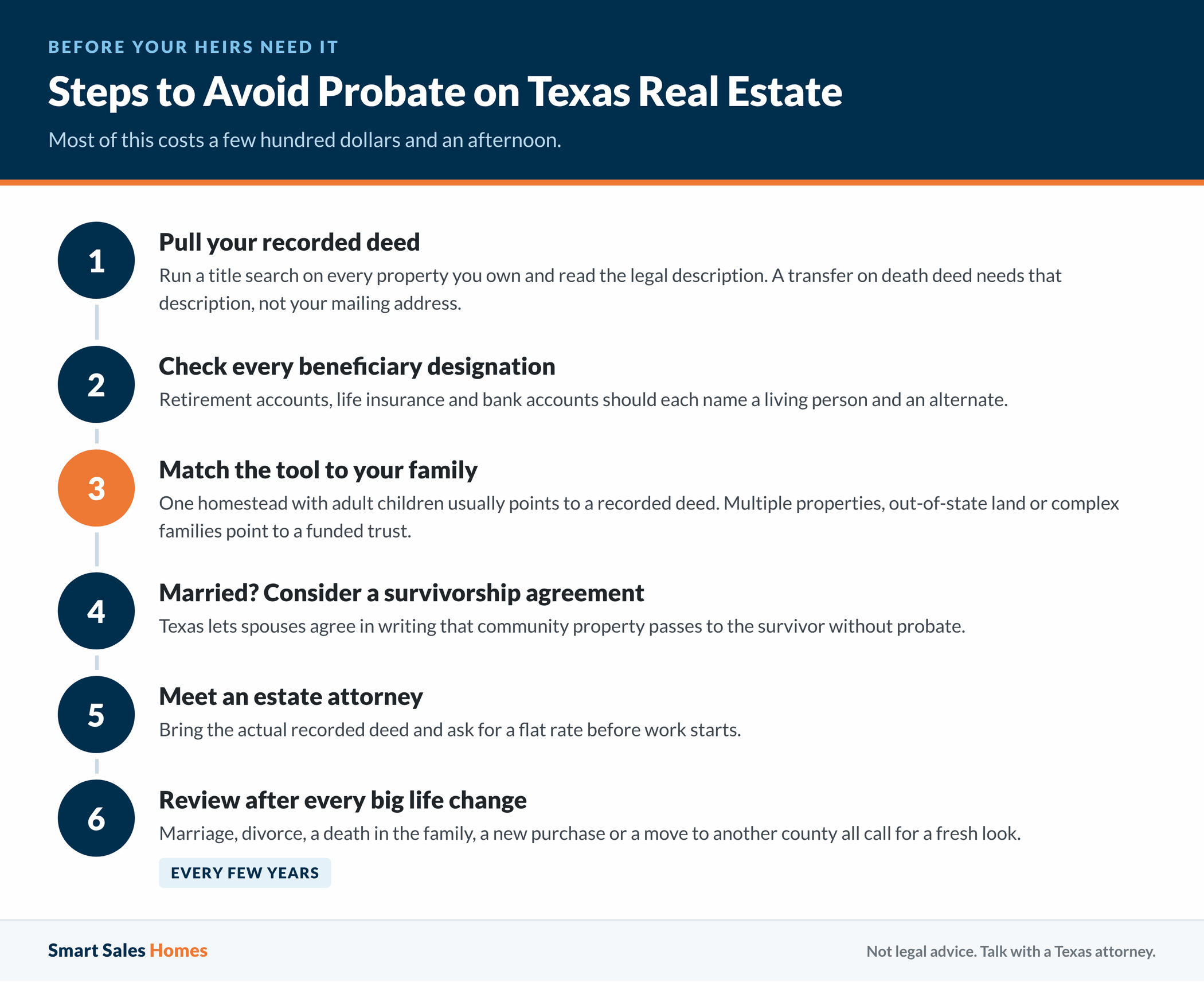
Beneficiary forms help you avoid probate too, so confirm each retirement account, life insurance policy and bank account names a living person and an alternate.
One homestead with adult children usually points toward a recorded deed. Multiple properties, out-of-state land, or complicated family dynamics point toward a funded trust.
Market conditions shape timing too. The typical Texas home sold in 99 days during the third quarter of 2026, two days longer than the same quarter a year earlier. Add three months on market to a probate timeline and your heirs are carrying costs well into a second year.
Are your heirs equipped to maintain a vacant house through a Texas summer?
Families who want to sell quickly after inheriting sometimes find that a direct buyer removes the repair and showing burden altogether. Smart Sales Homes works with Texas families in exactly that spot. We can tell you plainly whether a traditional listing would serve you better.
What Questions Should You Ask a Texas Attorney About Avoiding Probate?
Bring your deed to the meeting. Not a copy of the tax statement, not the appraisal district printout, the actual recorded deed with the legal description on it. Attorneys can work ten times faster with that page in front of them, and you’ll spend less on the consultation.
Ask whether a transfer on death deed or a trust is the better way to avoid probate in your situation. Make them explain why without jargon. A good Texas estate attorney will sometimes tell you the simpler option is enough.
Other questions worth writing down before you go: Does my current will authorize independent administration? Should my spouse and I sign a survivorship agreement? What happens if one of my children dies before I do, and how does my homestead exemption interact with whichever tool we choose?
Ask about Medicaid too, if long-term care is on the horizon. Property passing by transfer on death deed isn’t part of the probate estate, so Texas Medicaid estate recovery can’t reach it under Section 114.106(b). That single fact changes the planning for a lot of families with a parent heading into assisted living.
Many Texas attorneys quote flat rates for the deed work and simple estate plans that help families avoid probate. Know the number before work starts.
An heir in New Braunfels reached out about her father’s house after he passed. He’d recorded a transfer on death deed years earlier, so the 1970s brick ranch went straight to her and her two brothers. That let them avoid probate with little more than a death certificate and an affidavit of death. With the garage still full of fishing gear, we bought it as-is, they split the proceeds, and nobody sorted a single box.
Texas families in that position should know selling as-is is a legitimate choice, not a surrender. Some heirs would rather not spend a summer hauling a parent’s belongings to the dump. For them, Smart Sales Homes will give a straight answer about what the property is worth as it sits.
Frequently Asked Questions About How to Avoid Probate in Texas
Is Probate Always Required for Texas Property?
No. Say every asset carries a beneficiary designation, sits in a funded trust, or passes under a recorded deed. Your heirs may then never file anything with a probate court. Texas also offers faster paths like muniment of title and the small estate affidavit when probate can’t be skipped. A Texas probate attorney can review your specific holdings and tell you which category you fall into.
Why Would a Family Choose Not to Probate a Will?
Plenty of families skip it because there’s nothing left to probate. If the house already transferred by deed and the accounts paid out to named beneficiaries, filing the will accomplishes nothing but legal bills. Other families never file because they didn’t know about the four-year window described earlier. By the time a title company asks questions, their options have narrowed to heirship proceedings.
Can Heirs Sell an Inherited Texas House Before Probate Finishes?
It depends on how title stands. When a recorded deed or survivorship agreement already moved ownership, the heirs can list or sell immediately with a death certificate and proper documentation. Without one of those tools, a title company will generally require court authority before it insures the sale. The probate path has to run its course first.
Does a Transfer on Death Deed Avoid Probate If There’s Still a Mortgage?
Yes, the deed still works, but the loan comes along with the house. Your beneficiary inherits the property along with whatever balance remains, and they’ll need to keep payments current or refinance. Talk to your lender and your attorney together if the mortgage balance is large relative to the property’s value.
How Often Should I Review My Plan to Avoid Probate in Texas?
Every few years, and immediately after any major life change. Marriage, divorce or a death in the family all deserve a fresh look at your documents. So does buying another property or moving to a different Texas county. Deeds and beneficiary forms quietly go stale, and the people who discover that are usually your heirs at the worst possible moment.
Maybe you’re sitting on an inherited Texas property and can’t decide whether to fix it up, list it or just be done with it. We’re glad to talk it through. No pressure, no obligation, and if the right move is calling an attorney instead of selling, we’ll tell you that too.
How to Avoid Probate on a San Antonio Home
Bexar County is one of the counties with the specialized courts described above. Families here who never take steps to avoid probate usually end up in front of one of those judges. The San Antonio Board of Realtors put the area’s median home price at just under $299,000 in October 2026. On a house worth that much, a recorded deed costs very little next to months of court time and carrying costs.
Anyone already holding an inherited house in San Antonio or elsewhere in Bexar County, getting the title in order first keeps every option open. You can keep it, rent it, list it or sell it as is once the paperwork lines up.
Talk With Smart Sales Homes About an Inherited Texas House
Whether the title is clean or still tangled in probate, we’ll give you a fair cash offer. We’ll also tell you honestly if waiting on the court makes more sense. Contact Smart Sales Homes or fill out the short form below to get started.